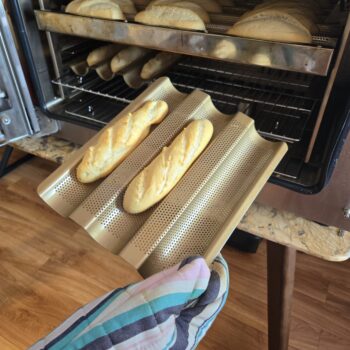
Home-Baked Bánh Mì (Vietnamese Baguette)

A home-baker's adaptation of the classic Vietnamese short baguette, with a thin crackling crust and an airy interior — built to be split and filled. Adapted from Lua's Kitchen, Ho Chi Minh City.
Ingredients
For the poolish (night before)
- 50 g bread flour (12–13% protein)
- 50 g water, room temperature
- 2 g instant yeast
For the main dough
- All of the poolish from above
- 250 g bread flour
- 110 ml water (50/50 ice and room-temp in hot weather)
- 25 g whole egg, beaten
- 2.5 g instant yeast
- 10 g sugar or honey
- 4 g fine salt
- 15 g neutral oil or softened butter
- 10 ml fresh lime juice
For baking
- 150 ml hot water (for steam)
Instructions
- In a glass jar or bowl, stir together the 50 g water and 2 g yeast until the yeast dissolves. Add the 50 g bread flour and stir to a smooth paste. Cover loosely and leave at room temperature for 5 to 10 hours, until tripled in volume, domed on top, and pocked with bubbles. In tropical weather it ferments faster; in a Sydney winter, leave it longer.
- In the bowl of a stand mixer, combine the 250 g bread flour, 2.5 g yeast, and 10 g sugar. Whisk briefly to distribute. In a separate jug, stir together the 110 ml water, beaten egg, and lime juice. Pour into the poolish jar and stir until the poolish dissolves into the liquid. Tip the lot into the mixer bowl.
- Mix on low for 2 minutes until incorporated. Add the salt. Increase to medium and mix for 5 minutes. Add the oil and continue on medium for 5 to 8 minutes more, until the dough is smooth, elastic, pulls cleanly from the bowl, and passes the windowpane test — a small piece stretched between your fingers should let light through without tearing.
- Lightly oil your hands and work surface. Tip the dough out, fold it on itself four to six times, shape into a ball. Return to a lightly oiled bowl, cover with a damp tea towel, and rest at warm room temperature for 30 to 60 minutes, until doubled.
- Divide into 5 equal portions of approximately 100 g each. Roll each into a tight ball, mist with water, cover, rest 10–15 minutes. To shape each loaf: gently flatten into an oval, fold the top third down and press the seam, then the bottom third up. Roll the cylinder under your palms from centre outward, tapering into a short baguette about 15 cm long. Place seam-down on a perforated bánh mì pan or parchment-lined tray.
- Cover loosely with a tea towel and proof at warm room temperature — ideally 28°C — for 75 to 90 minutes. In a cool kitchen, proof inside a turned-off oven with a bowl of warm water beside the loaves. The loaves are ready when they have grown to roughly 2.5 times their shaped size and feel pillowy.
- Twenty minutes before baking, set an oven rack to the middle position and place a heavy cast iron pan or empty baking tray on the lower rack. Preheat to 240°C (465°F).
- Hold a sharp blade or bread lame at a low angle — about 30 degrees to the loaf — and make one long shallow slash down the length of each. About 5 mm deep. Mist generously with water, especially into the cuts.
- Place the loaf pan on the middle rack and immediately pour the 150 ml of hot water into the heated pan below. Close the door fast to trap the steam. Bake at 230°C with fan on for 8 minutes. Do not open the door.
- Open the oven, mist the loaves once more with water, remove the steam pan, and reduce to 190°C (375°F) with fan off. Bake a further 10 to 12 minutes, until the crust is deep golden and crackles when you tap the underside. Rotate the pan halfway through.
- Transfer to a wire rack. If you have a fan, point it at the loaves — the crust contracts as it cools and fine cracks should appear within 5 to 10 minutes. This is the sound of a properly steamed bánh mì.
Notes
Best within 4 hours of baking. After that, refresh in a hot oven for 3 minutes.
For a thinner crust, mist the loaves once more during baking.
For a darker crust, shorten the final proof and extend the second bake.
Lime juice replaces ascorbic acid as a gluten strengthener. Don't exceed 10 ml — too much acidity inhibits the yeast.
Salt is non-negotiable. Without it, the loaf is pale and rises wildly. Stick to the weight.
Adapted from a class with Lua's Kitchen in Ho Chi Minh City: https://www.instagram.com/luaskitchen.cookingclass/